
 Zodiac Timeline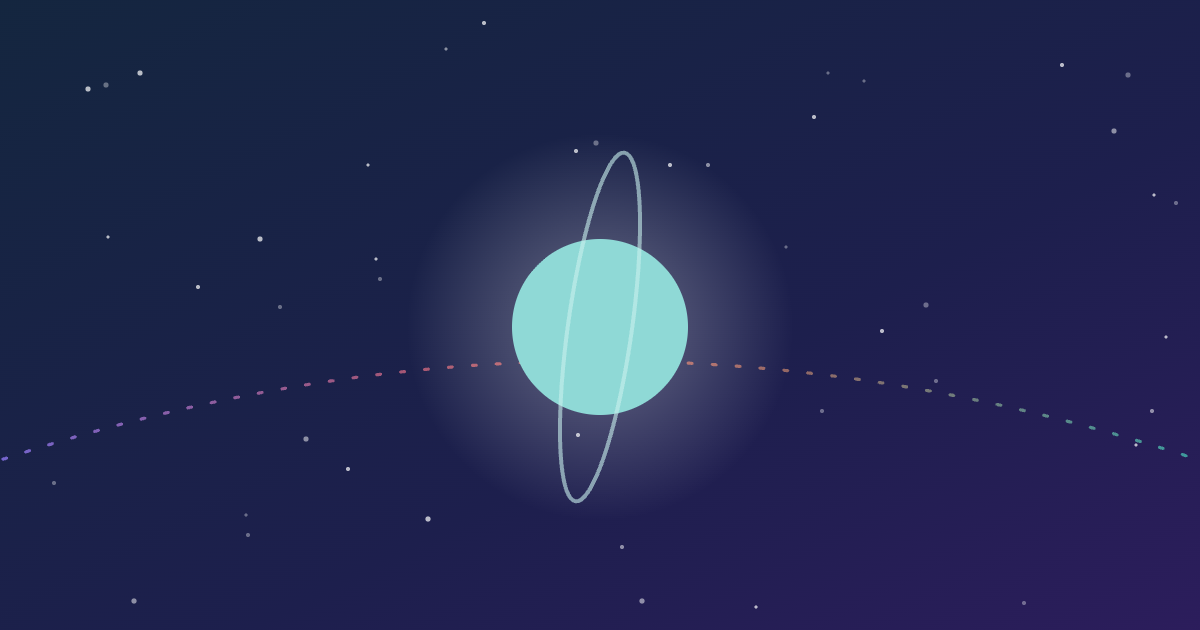
What is Uranus?
Uranus is the seventh planet from the Sun: an ice giant about 51,100 km across, four times Earth’s width, blue-green from methane in its atmosphere. It is tipped on its side, its axis tilted about 98°, so each pole gets 42 years of sunlight and then 42 years of dark. It orbits the Sun at an average of 2.87 billion km (19.2 au) and goes around in 84 years. William Herschel discovered it in 1781, the first planet found with a telescope.
Where Uranus is in the sky
The ecliptic is the path the Sun appears to follow across our sky over a year, the plane of Earth’s orbit seen from Earth. Positions along it are measured in degrees, from 0° at the March equinox to 360°. The zodiac divides it into twelve equal 30° parts named after signs: Aries covers 0° to 30°, Taurus 30° to 60°, and so on. The signs are counted from the equinox, not from the star patterns they were named after; those constellations now sit about 24° further along, because Earth’s axis slowly wobbles (precession).
Uranus moves along the ecliptic at up to about 0.06° a day and spends about seven years in each sign, going around the zodiac in 84 years.
Uranus in astrology
In astrology Uranus stands for change, freedom, invention and sudden breaks from routine. It is the modern ruler of Aquarius. Because it spends about seven years in a sign, astrology reads its sign as a theme of a generation.
Uranus and your sign
Astrology also reads the twelve signs as twelve houses, each one an area of life, counted from your own sign: your sign is your 1st house, the next sign your 2nd, and so on around the zodiac. So Uranus, now in Gemini, falls in a different house for every sign. For example, Gemini is the 3rd house for Aries, the house of communication and learning. Find your sign below, and read your daily horoscope for how the day plays out.
- Aries 3rd house · communication and learning
- Taurus 2nd house · money and values
- Gemini 1st house · self and fresh starts
- Cancer 12th house · rest and reflection
- Leo 11th house · friends and future plans
- Virgo 10th house · career and reputation
- Libra 9th house · travel and beliefs
- Scorpio 8th house · intimacy and shared resources
- Sagittarius 7th house · partnerships
- Capricorn 6th house · work and wellbeing
- Aquarius 5th house · romance and creativity
- Pisces 4th house · home and family
Frequently asked questions
- Why is Uranus tilted on its side?
- Most likely a collision with a large body early in its history knocked it over; its axis is tilted about 98°.
- How long is Uranus in each sign?
- About seven years; it goes around the zodiac in 84 years.
- Can I see Uranus?
- Just barely without a telescope, under very dark skies and if you know exactly where to look; binoculars make it easy.
- What does Uranus mean in astrology?
- Change, freedom, invention and surprise. It is the modern ruler of Aquarius.